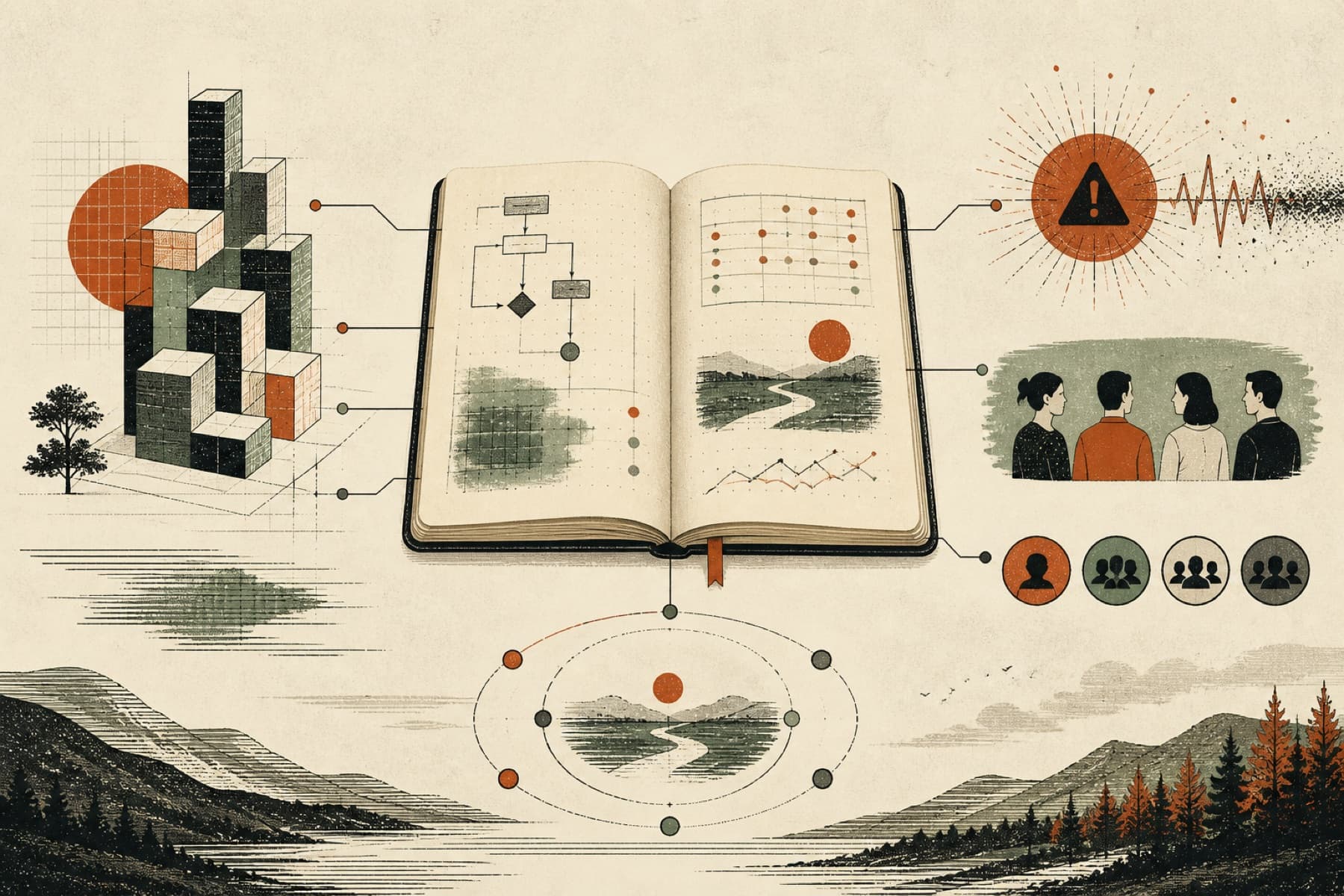
A CTO's most expensive problem is often not a missing answer. It is an answer that existed, shaped a decision, and then disappeared into a meeting or chat thread. A useful notebook turns that transient context into an operating asset.
Write for the next decision
The notebook is not a diary and it is not a warehouse for every note. Each entry should help a future decision happen faster or with better context. I keep a small set of recurring documents: decision records, incident reviews, weekly operating notes, delivery risks, and hiring observations.
A decision record captures the problem, constraints, options considered, choice, and what would cause us to revisit it. The goal is not to prove that the choice was correct forever. The goal is to preserve why it was reasonable at the time.
Incidents should change the system
An incident review begins with a timeline built from evidence, not memory. It describes user impact, detection, contributing conditions, and recovery. The most valuable section is the set of system changes that follow: better limits, clearer ownership, safer defaults, improved alerts, or a reduced blast radius.
Avoid action lists made entirely of “be more careful.” If the same conditions return, the system should make the mistake harder to repeat and easier to detect.
Keep a visible risk register
Teams naturally report progress. Risks remain implicit until they become urgent. A short weekly register makes uncertainty discussable: what might prevent the outcome, how likely it is, what signal would confirm it, and who owns the next action.
This is especially useful for dependencies between product and platform work. A launch date is not credible if a critical migration, external approval, or capacity test has no owner.
Record principles through examples
Statements such as “we value quality” are too abstract to guide work. The notebook should connect principles to decisions. If latency is a feature, record the budget chosen for an order flow. If production is the honest feedback loop, record how a small release was scoped and observed. Examples turn culture into something a new teammate can apply.
Make writing part of the cadence
The notebook works only when it is cheaper than reconstructing context. Templates help. Decision records should take minutes, not days. Weekly notes should link to evidence instead of repeating dashboards. Incident reviews should happen close enough to the event that details are available, but after the system is stable.
A good cadence might include a short operating note each week, a decision record whenever a meaningful trade-off becomes durable, and a monthly review that closes stale risks.
Separate signal from archive
Not every document deserves equal attention. Keep a current index with active decisions, risks, and recent incidents. Archive completed material without deleting it. The front door stays small while the history remains searchable.
The result is not more documentation. It is less organizational amnesia. A well-kept CTO notebook lets the team disagree with the actual reasoning, learn from real failures, and move without repeatedly paying to rediscover its own context.