Systems & infrastructure
Real-time, event-driven, and latency-aware.
- Node.js
- TypeScript
- Go
- PostgreSQL
- Redis
- WebSockets
- Kafka
- gRPC
Vol. 01 — Indore · Foundry notes
Entrepreneur · Co-founder & CTO, Localstreet
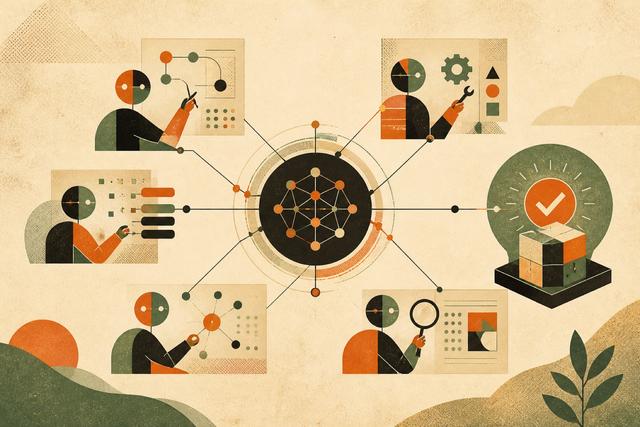
Keshav Suman is an entrepreneur and Co-founder & CTO at Localstreet, building AI-enabled hyperlocal commerce across Flutter applications and real-time systems, while creating Tomorrow as an independent multi-agent project.
The book in progress
A practical handbook for building agents that use tools, recover from failure, and finish real work.
01 — About
I am an entrepreneur and systems builder who turns ambiguous ideas into shipped products. I am the co-founder and CTO of Localstreet, where our AI-enabled platform and Flutter applications connect neighbourhood merchants to digital commerce in real time.
At Localstreet, AI drives multiple steps across our organisation and operating workflows. My work spans the intelligence layer as well as the real-time infrastructure behind the product.
My work lives at the intersection of real-time infrastructure, hyperlocal commerce, and autonomous agents. Since 2026, I have been creating Tomorrow as an independent multi-agent orchestration project for coordinating planning, delegation, execution, and verification.
I care about latency, craft, and the moment an agent actually completes a task end-to-end. I write about the engineering behind these ideas and occasionally about the philosophy of building.
02 — Craft
Real-time, event-driven, and latency-aware.
From zero to live, across web and mobile.
Orchestration, tool use, and guardrails.
Shipping with taste and accountability.
03 — Selected work
AI-enabled hyperlocal commerce, in real time.
An AI-enabled platform connecting neighbourhood merchants to digital commerce through Flutter applications, real-time inventory, live orders, and AI-driven organisational workflows.
An independent multi-agent orchestration project.
An experimental system I created to coordinate specialist agents across planning, delegation, execution, and verification. Tomorrow is a technical project, not a company.
04 — Ledger
Building an AI-enabled hyperlocal commerce platform that connects neighbourhood merchants to digital commerce through Flutter applications, live inventory, real-time orders, and intelligent operations.
Created an independent multi-agent orchestration system that coordinates specialist agents through planning, delegation, execution, governance, and verified outcomes.
06 — Papers I have read
Papers I have read and found valuable while learning about transformers, alignment, reinforcement learning, tool use, and autonomous agents. The original researchers and publication links are credited below.
Ashish Vaswani, Noam Shazeer, Niki Parmar et al.
Introduced the Transformer: an attention-based architecture that removed recurrence and became the foundation of modern large language models.
Jacob Devlin, Ming-Wei Chang, Kenton Lee, Kristina Toutanova
Established deep bidirectional language pre-training and showed how a single pretrained model could be adapted to a wide range of language-understanding tasks.
Volodymyr Mnih, Koray Kavukcuoglu, David Silver et al.
Combined deep neural networks with reinforcement learning in the DQN agent, learning successful control policies directly from high-dimensional visual input.
Long Ouyang, Jeff Wu, Xu Jiang et al.
Demonstrated a practical reinforcement-learning-from-human-feedback pipeline for making language models more helpful, truthful, and aligned with user intent.
Shunyu Yao, Jeffrey Zhao, Dian Yu et al.
Interleaves reasoning traces with actions, giving language-model agents a practical way to plan, use external tools, gather evidence, and update their decisions.
Timo Schick, Jane Dwivedi-Yu, Roberto Dessì et al.
Shows how a language model can learn when and how to call external APIs with limited supervision, a central capability for reliable tool-using AI systems.
Noah Shinn, Federico Cassano, Ashwin Gopinath et al.
Introduces verbal feedback and episodic memory as a way for agents to reflect on failed attempts and improve later decisions without updating model weights.
Joon Sung Park, Joseph C. O’Brien, Carrie J. Cai et al.
Presents an agent architecture built around observation, memory, reflection, and planning to produce believable long-horizon behavior in an interactive environment.
Get new posts in your inbox. No spam, unsubscribe anytime.