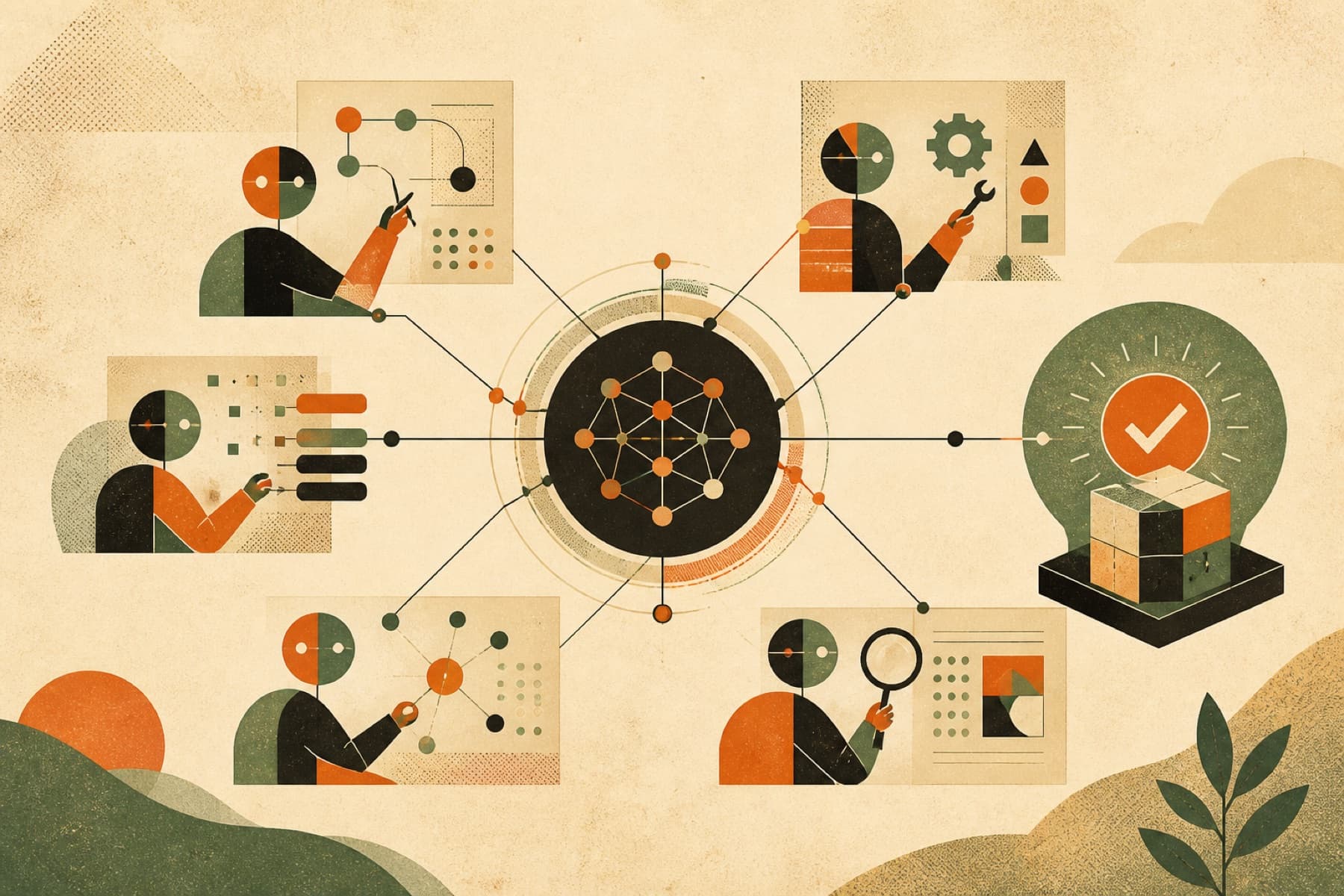
An autonomous agent is not a chatbot with a longer prompt. It is a software system that observes state, chooses an action, uses a tool, evaluates the result, and keeps going until a clearly defined outcome is reached. The interesting engineering begins after the first model call.
Start with the outcome
The most useful agent specifications look less like personas and more like contracts. Define the artifact that must exist when the run finishes, the checks it must pass, and the actions the system may take. A coding agent, for example, should not be considered successful because it produced a patch. Success means the patch is applied, types compile, relevant tests pass, and the final response explains what changed.
This distinction prevents a common failure mode: optimizing for plausible narration instead of completed work. The agent should be rewarded for verified state transitions, not for sounding confident.
Tools are the real capability surface
A model can reason about a repository, but it cannot change one without tools. Each tool should expose a narrow operation with typed inputs, predictable output, and an explicit failure shape. Reading a file, searching symbols, applying a patch, running a test, and opening a pull request are separate capabilities. Keeping them separate makes behavior observable and permissions understandable.
Good tools also return evidence. A test tool should provide the exit code and relevant output. A search tool should return paths and line numbers. Evidence lets the next decision depend on reality instead of the model's memory of what it intended to do.
Memory should be structured, not endless
Stuffing an entire session into the context window eventually makes the agent slower and less precise. I prefer three layers: immediate working context, a compact task ledger, and durable project knowledge. The working context holds the current files and tool results. The ledger records decisions, open questions, and verification status. Durable knowledge contains stable facts such as repository conventions.
The rule is simple: save conclusions and evidence, not every token that led to them.
Plan in small, reversible steps
Long plans become fiction as soon as the environment disagrees. An effective agent plans one or two meaningful actions ahead, executes them, observes the result, and revises. Risky operations should have tighter feedback loops than routine reads. Changes should be small enough to inspect and reversible enough to recover from.
A useful loop is:
- Inspect the current state.
- State the next concrete change.
- Execute with the narrowest tool.
- Verify the changed state.
- Update the task ledger.
Verification is a hard gate
Verification cannot be a suggestion at the end of the prompt. It needs to be part of the control flow. If a code change requires typecheck and tests, the run is not complete until those commands pass or the agent reports a specific blocker. The verifier should be able to reject the worker's output and send actionable evidence back for another attempt.
This is also where human trust is earned. People delegate more when the system can show what it changed, which checks ran, and what remains uncertain.
Design for failure and recovery
Tools time out. APIs return partial data. A worker edits the wrong file. The model loses an assumption during summarization. Production agents need bounded retries, idempotent operations, checkpoints, and clear escalation rules. Retrying the same action with the same inputs is rarely a recovery strategy; the system should change its approach or ask for help.
The goal is not perfect autonomy. It is dependable progress with visible boundaries. Start with a narrow workflow, measure where it fails, and expand authority only after the agent consistently completes the smaller job. That is how an impressive prototype becomes infrastructure you can actually trust.
A production execution loop
This loop interleaves reasoning with environment action, similar to the approach explored in ReAct. A production harness adds strict permission and completion boundaries around that loop.
Tool contracts and idempotency
type ToolResult<T> =
  | { ok: true; value: T; evidence: string[] }
  | { ok: false; kind: 'retryable' | 'terminal' | 'approval'; message: string };
Every side-effecting tool needs a stable idempotency key because the system can lose an acknowledgement after the action succeeded. Validation, authorization, and execution belong to the host application rather than the model.
Failure and approval matrix
| Condition | Response |
|---|---|
| Timeout or 503 | retry with backoff and jitter |
| State version conflict | reread state and re-plan |
| Invalid arguments | repair once from schema evidence |
| Financial or irreversible action | request scoped human approval |
| Policy violation | stop and record denial |
Evaluate complete tasks
Track task success, verification pass rate, retries, tool failures, human intervention, elapsed time, and cost per successful outcome. Promote production failures into a regression set. Reflexion is useful background for episodic feedback, but reflection should guide another attempt—not replace environmental verification.
Continue with the production AI agents cornerstone.